
Tag: health

  • “Here’s Your Co-Pay. No, Actually, You Pay.”

    “Here’s Your Co-Pay. No, Actually, You Pay.”

    I’ve spent 50 years in business. I have a BBA and an MBA. I’ve read contracts, financial statements, purchase agreements and enough fine print to permanently damage my eyesight.

    Then somebody handed me a health insurance policy.

    I didn’t understand a damn thing.

    Apparently, the health insurance industry decided healthcare wasn’t complicated enough. So they invented their own language.

    Office Visit

    I’ve visited friends.

    I’ve visited relatives.

    I’ve even visited France.

    Doctor Office visit? 

    Thanks for visiting. That’ll be $175.”

    Deductible

    Now there’s a word I recognized.

    I’ve been doing tax returns for 50 years.

    Mortgage interest? Deductible.

    Business expenses? Deductible.

    Charitable contributions? Maybe deductible.

    So when my health insurance company said I had a $2,500 deductible, I thought:

    Great. Where do I put it on my tax return?

    Apparently, that’s not what deductible means.

    I got audited

    It means I pay the first $2,500.

    Why didn’t they just say that?

    Co-Pay

    This one sounded encouraging.

    “Co” means we’re doing this together.

    Like co-worker. Co-pilot. Co-owner.

    So who’s my co-payer?

    Apparently, me.

    I go to the doctor and pay $40.

    Specialist? $75.

    Urgent care? $100.

    Emergency room?

    At this point, I think we should eliminate the confusion and rename it:

    I-Pay.

    Coinsurance

    Wait I already bought insurance.

    Now I need insurance for my insurance?

    Not exactly.

    Coinsurance means that even after I pay my deductible, I may still pay a percentage of the bill.

    The insurance company might pay 80%.

    I pay 20%.

    So I pay a premium so I can have insurance.

    Then I pay the deductible so I can use the insurance.

    Then I pay coinsurance after I’ve used the insurance.

    Networks 

    In-Network

    This means your doctor has an agreement with your insurance company.

    Good.

    Out-of-network means your doctor doesn’t.

    Not so good.

    The problem is figuring out who’s in which network.

    Your doctor may be in-network.

    The hospital may be in-network.

    The anesthesiologist who appears for 11 minutes while you’re unconscious?

    Good luck.

    Prior Authorization

    Here’s another beauty.

    Your doctor examines you and decides you need a test.

    But before you can have it, the insurance company may want to decide whether you need it too.

    Apparently, medical school is no longer enough.

    You also need permission from someone you’ve never met.

    Explanation of Benefits

    After all this, the insurance company sends you an EOB — Explanation of Benefits.

    Across the top, in large letters, it says:

    THIS IS NOT A BILL.

    Then it contains:

    Amount billed: $4,850

    Allowed amount: $2,375

    Plan paid: $1,420

    Your responsibility: $955

    Naturally, you spend the next 20 minutes trying to figure out:

    If this isn’t a bill, why are you telling me I owe $955?

    Now Compare the Plans

    This is where health insurance reaches its full potential.

    Plan A has a lower deductible but a higher premium.

    Plan B has a lower premium but higher coinsurance.

    Plan C has better prescription coverage but your doctor isn’t in the network.

    Plan D has a $7,500 out-of-pocket maximum, unless something doesn’t count toward the out-of-pocket maximum.

    So you finally ask the insurance agent the only question that matters:

    “Which plan gives me the best coverage at the lowest price? 

    And the answer is basically:

    “How sick are you planning to be next year?”

    That’s the problem.

    You’re choosing insurance today based on diseases, accidents, prescriptions, specialists, MRIs and emergency-room visits that haven’t happened yet.

    What the Hellth! 

    You can’t make this stuff up.

    More reading at Crazyfamily.blog

    At 75, I Went to the Hospital. The Confusion Started Immediately.
  • At 75, I Went to the Hospital. The Confusion Started Immediately.
    At 75, I Went to the Hospital. The Confusion Started Immediately.

    At 75, I thought I had a reasonably good command of the English language.

    Then I went to the emergency room.

    Apparently, hospitals have stopped using English.

    Going to the ER used to be simple. You walked in and said, “I’m sick.”

    Someone looked at you and said, “Okay. Sit down.”

    Not anymore.

    Today, before anyone determines whether you’re actually going to live, you first have to prove who you are, where you live, who your doctor is, what medications you take, what you’re allergic to, who should be called if you die and whether you have any idea why you came there in the first place.

    Then they hand you an electronic pad.

    “Sign here.”

    I signed.

    “Here.”

    I signed again.

    “Initial here.”

    Then another signature.

    After signing enough documents to buy a house, refinance it and leave it to my children, I was beginning to develop carpal tunnel syndrome.

    I finally asked what I had agreed to.

    Apparently, everything.

    Treatment. Privacy. Release of information.

    And HIPAA.

    HIPAA protects your medical privacy, which is reassuring. Apparently, before HIPAA, hospital employees just wandered around telling people:

    “Hey, did you hear what Voll has?”

    Now they can’t tell anyone anything.

    Occasionally, including you.

    I picture a courtroom.

    “Mr. Voll, how do you plead?”

    “Not guilty.”

    “Your Honor, due to HIPAA regulations, we’re unable to tell the defendant what he’s charged with.”

    “Excellent. Proceed.”

    Eventually, a nurse appeared.

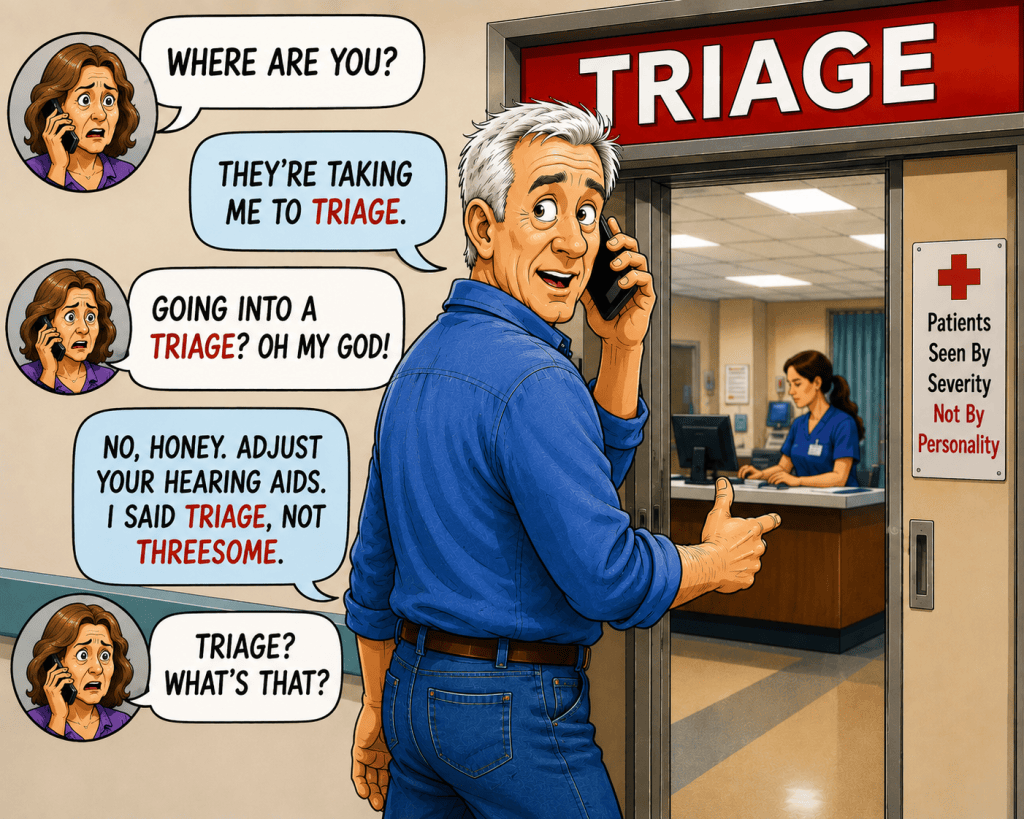
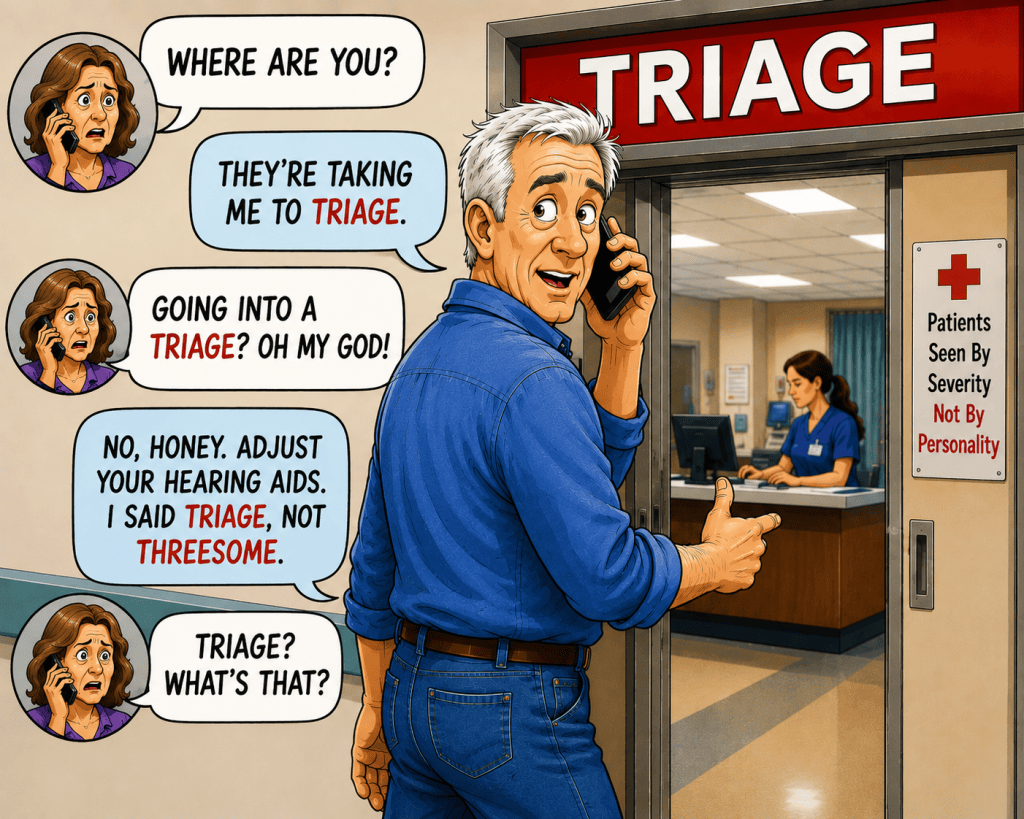
    “Mr. Voll, we’re ready for your triage.”

    My what?

    At 75, I thought I’d heard just about everything.

    Apparently not.

    I looked around.

    There was a nurse.

    There was me.

    I wasn’t sure who the third person was supposed to be.

    Then I realized she’d said triage.

    Not threesome.

    That was disappointing.

    Apparently, triage is where they decide how quickly you need medical attention.

    Blood pressure. Temperature. Pulse. Oxygen.

    Then came the big question.

    “On a scale of one to ten, how severe is your pain?”

    I’ve never understood that question.

    What exactly is a ten?

    Kidney stone?

    Shark attack?

    Notre Dame losing to USC?

    Give me some parameters.

    Eventually, the doctor came in.

    That’s when I discovered there’s another language you need to learn before going to the hospital:

    Abbreviations.

    MRI. PSA. IBS. ICU.

    I decided to translate them myself.

    MRI — Might Reveal Injury

    PSA — Prostate Says Attention

    IBS — I Better Sprint

    And my personal favorite:

    ICU — I See You

    That one seems unnecessarily obvious.

    If I’m lying in intensive care and the nurse walks into the room, I already know she sees me.

    Then the doctor started speaking fluent Hospital.

    “Your CBC looks okay, but I’d like a CMP, maybe a CT, and then we’ll have you follow up with your PCP.”

    I nodded thoughtfully.

    “Absolutely.”

    I had absolutely no idea what he’d just said.

    But at 75, I’ve learned something important.

    If a doctor uses more than three abbreviations in one sentence, just nod.

    Eventually, I made it out of the ER.

    I survived Registration.

    I survived HIPAA.

    I survived the pain scale.

    I even survived the alphabet.

    And I learned one very important lesson about modern medicine:

    The next time a nurse tells me she’s ready for my triage—

    I’m going to listen very carefully before getting too excited.