

Tag: politics

  • Congress:  What Are We Getting for Our Money?

    Congress: What Are We Getting for Our Money?

    If I invested $2 million in a business, I’d want to know what it was doing for its customers.

    So I have a question about Congress: What are we getting for our money?

    A typical U.S. representative earns a salary of $174,000. Add the average authorized budget to run the office, and the annual figure is about $2.1 million. For a senator, it is about $4.8 million. Most of that money pays for staff and official operations. It does not go into the member’s pocket. (everycrsreport.com⁠)

    That is a substantial public investment. What return should we expect?

    To me, the first responsibility is clear: represent the people back home. Constituents are the people who live in the district or state, including those who voted for someone else. They deserve an office that listens, responds, helps them navigate federal agencies, and brings their concerns into decisions in Washington.

    Members also have national responsibilities. They vote on legislation, serve on committees, and oversee federal agencies. Those duties can have a direct effect on the people they represent.

    But how does a member divide the day among all of it?

    Turn on the television and you may see a familiar face discussing the latest fight in Washington. Turn to another channel, and there’s another interview. Meanwhile, there are committee meetings, votes, constituent requests, and the continuing effort to raise money for the next election.

    I’m not suggesting an interview is automatically a waste of time. Explaining a vote or an issue can be part of the job. I am asking a question we cannot answer by counting the days Congress is in session:

    How much of a member’s time goes toward serving constituents, and how much goes toward building a national profile and getting reelected?

    There are two money systems here. Taxpayers fund the congressional office. Donors fund campaigns and political committees. Individuals and PACs can contribute to candidates within legal limits; Super PACs can raise unlimited amounts for independent political spending. That campaign money is separate from the office budget, but fundraising still makes a claim on a politician’s time. (fec.gov⁠, fec.gov⁠, fec.gov⁠)

    Representatives face reelection every two years. Senators serve six-year terms. Winning an election tells us who voters chose. It does not tell us whether someone who called the office got a response, whether a federal-agency problem was followed through, or whether local concerns were heard. (uscode.house.gov⁠)

    In business, I couldn’t tell my clients, “You’ll get a chance to review my performance in two years.” They’d tell me what was going wrong long before then.

    Why not ask constituents?

    I’d like each congressional office to publish an annual report on its work and invite independent feedback in years when its member is not on the ballot. Ask constituents straightforward questions:

    • Did the office respond when you contacted it?
    • If you asked for help with a federal agency, was the follow-up useful?
    • Does the member explain how national issues affect this district or state?
    • What local concern needs more attention?

    Publish the questions, how the survey was conducted, how many people responded, and the results. An open online poll could be a place to hear comments, but it shouldn’t be presented as the opinion of everyone in the district or state.

    Then tell us what the office intends to do with the answers.

    That seems like a reasonable request when we are investing millions of dollars a year in each office. We should be able to see the work, hear from the people it serves, and ask whether our representatives are giving those people enough of their time.

    After all, we’re the constituents. We’re also paying the bill.

    More stories…. Crazyfamily.blog
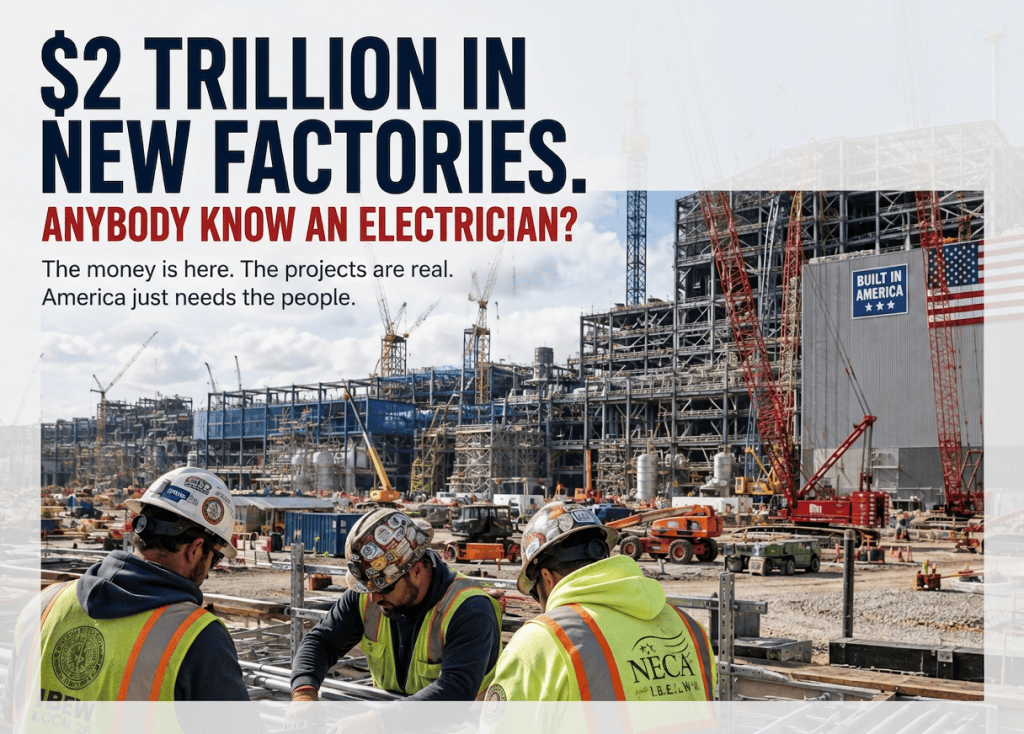
  • “Who’s Going to Make This Stuff?”  America has $2 Trillion to Build.

    “Who’s Going to Make This Stuff?” America has $2 Trillion to Build.

    The investment commitments to rebuilding the U.S. manufacturing base are huge.

    One current estimate puts more than $2 trillion in U.S. mega-projects on the board—roughly double the level two years ago and about 10 times the announced spending five years ago.

    Let’s put $2 trillion into perspective.

    $2 trillion = $2,000 billion.

    That’s theoretically enough money to finance 2,000 projects costing $1 billion each.

    These include semiconductor fabs, battery plants, advanced manufacturing facilities, AI/data centers, energy projects and related infrastructure.

    Now look at the other end of the American economy.

    Small businesses employ approximately 63 million Americans—45.9% of the private-sector workforce—and generate about 43.5% of U.S. GDP.

    Here’s another way to understand a trillion dollars:

    $1 trillion could theoretically build 100,000 new $10 million businesses

    Big or small…

    We’ve got a problem.

    Actually, we’ve got two:

    1. Who’s going to build all this stuff?

    2. Once it’s built, who’s going to make all this stuff?

    WORKFORCE #1: BUILDING THE STUFF

    New industrial projects require electricians, welders, pipefitters, plumbers, HVAC technicians, millwrights, heavy-equipment operators, construction workers, engineers and construction managers.

    And America already needs enormous numbers of them.

    Projected annual U.S. job openings include approximately:

    Electricians: 81,000
    Industrial machinery mechanics, maintenance workers and millwrights: 54,200
    Welders: 45,600
    HVAC technicians: 40,100

    That’s approximately:

    220,900 OPENINGS EVERY YEAR

    in just those four occupational groups.

    And that doesn’t include plumbers, pipefitters, engineers, equipment operators and many of the other people required to construct industrial facilities.

    America can build a major plant. We’ve proven that.

    One $5 billion plant can employ thousands of construction workers and eventually recruit and train thousands of permanent employees.

    But imagine 50, 100 or 200 major projects all trying to do that during roughly the same period.

    They’re all looking for electricians, welders, pipefitters, engineers, technicians and construction managers from overlapping labor pools.

    And here’s the part we sometimes forget:

    A lot of those people already have jobs.

    Many work for the small and midsize businesses that employ nearly half of America’s private-sector workforce.

    So creating millions of jobs isn’t necessarily the hard part.

    Creating millions of additional qualified workers is.

    WORKFORCE #2: MAKING THE STUFF

    This may eventually be the bigger problem.

    Deloitte and The Manufacturing Institute estimate that American manufacturing could require as many as:

    3.8 MILLION WORKERS BETWEEN 2024 AND 2033.

    And as many as:

    1.9 MILLION OF THOSE JOBS COULD GO UNFILLED

    if the skills and applicant gaps aren’t solved.

    Where does that enormous need come from?

    Roughly:

    2.8 million — replacing workers aging out of the workforce

    760,000 — jobs resulting from industry expansion

    230,000 — jobs resulting from recent investment, reshoring, infrastructure and technology policies

    America isn’t merely trying to create a new manufacturing workforce.

    It also has to replace a huge retiring workforce at the same time.

    THE IRONY

    We’ve spent years asking:

    “How do we bring manufacturing back to America?”

    Now we’re spending enormous amounts of money doing exactly that.

    And we may discover that bringing the factories back was the easy part.

    Because factories don’t manufacture anything by themselves.

    People do.

    Or at least people operate, program, maintain and repair the increasingly automated machines that do.

    So maybe America’s next major infrastructure program shouldn’t just be about concrete, steel, semiconductor plants and billion-dollar factories.

    Maybe it needs to be about:

    Trade schools. Apprenticeships. Community colleges. Technical training.

    And getting young people interested in manufacturing again.

    Because you can announce a billion-dollar factory tomorrow.

    You can buy the land.

    You can pour the concrete.

    You can install the robots.

    But eventually somebody has to know how to wire the building, operate the equipment and fix the robot when it stops working.

    Great News—America Is Building Trillions of Dollars of New Industrial Capacity.

    Anybody know an electrician?