Category: Humor

  • ” Thanks for the Invitation.  Where’s the Nearest  Motel 6? “

    ” Thanks for the Invitation. Where’s the Nearest Motel 6? “

    “We’d love to have you stay with us!”

    Very kind. Very generous.

    Very dangerous.

    I love visiting friends and family. Dinner, conversation, a few laughs. But somewhere between “Have another cup of coffee” and “We’ve already made up the guest room,” I start checking hotel availability under the table.

    At 75, I know what I need: a comfortable mattress, a nearby bathroom and the ability to leave a room without explaining where I’m going.

    Being a houseguest complicates all three.

    “Don’t be silly. Why spend money on a hotel? Stay here. You’re part of the family!”

    That sounds wonderful until you remember what being part of a family actually involves.

    Make yourself at home. Within limits.

    “Help yourself to anything in the refrigerator!”

    So I do.

    I find a strawberry popsicle in the freezer. Perfect. I unwrap it, take a bite and suddenly a snot-nosed kid appears, screaming like I’ve just backed over his bicycle.

    Apparently, it was HIS strawberry popsicle.

    Nobody mentioned that the freezer had property rights.

    Now his mother is looking at me like I stole his college fund, and I’m trying to figure out whether offering him the uneaten half will improve the situation.

    It doesn’t.

    The guest bedroom.

    “ That used to be our mattress before we got the new one.  It’s been a comfy one. We actually got it on sale at Discount Mattress the year we were married 25 years ago.”

    It might be comfy if you like a mattress which dips like the Grand Canyon.

    The bed also comes with enough decorative pillows to furnish a small hotel. I spend ten minutes removing them, then try to decide what to do with them.

    Do I make the bed? Strip the bed? Fold the sheets? Take to washer?  Not an issue at Motel 6.

    Worst of all…It happens to be the popsicle kids bedroom.   He is having a full drama workshop because he has to snuggle on the couch shared with Princess, their prized white standard poodle.

    This ain’t going to end well.

    Then there’s the guest bathroom.

    It’s booked solid all morning.

    Someone’s showering. Someone’s doing their hair. Someone’s in there so long I begin to wonder whether there’s another exit.

    When I finally get in, the toilet overflows.

    My fault, of course.

    Six people have been using it since dawn, but I’m the one standing beside it when the water comes over the rim. That makes me the prime suspect.

    Now I’m holding a plunger, standing in an inch of water and explaining that there was a preexisting condition.

    The toilet’s.

    Fortunately, there are six beautiful towels right in front of me.

    Unfortunately, they’re the guest towels.

    Guest towels are not for guests.

    You would think the name settles the question.

    It doesn’t.

    “You didn’t use those, did you?”

    Of course not. I dried my hands on my pants like a civilized houseguest.

    Those towels are part of the bathroom decor. They’re folded, layered and arranged in a way that suggests touching one might trigger an alarm.

    Meanwhile, the toilet is flooding the bathroom.

    I look at the water. I look at the towels.

    Apparently, we’d rather lose the floor.

    So what about Princess the family poodle.

    She has a beautiful poodle hairdo, manicured nails and absolutely no respect for my personal space.

    She wants to be petted. Then scratched. Then petted again.

    She sniffs me, jumps onto the couch and, just when I relax, sticks her nose in my crotch.

    “She likes you!”

    I’d prefer a handshake.

    The family is oblivious. They cannot imagine anyone not adoring their little Princess.

    Princess gets seven premium gourmet meals delivered every week by FedEx Priority.

    “We certainly can’t allow her to eat processed food.”

    I nod while eating my hot dog.

    The dog’s dinner arrived in an insulated container. Mine came in a package of eight.

    I’m tempted to slip her a bite, but I can already see how that ends: Princess makes a deposit on the living room carpet, and I’m responsible for another plumbing problem.

    I keep the hot dog to myself.

    I’m already wanted in connection with a popsicle.

    Don’t borrow their car.

    “Need to run to Walgreens? Take ours!”

    Good chance the gas gauge will be below a quarter tank.

    I can’t return it nearly empty. That would be rude.

    So I fill it.

    Then, under the gas station lights, I notice it could use a wash.

    They’ve been so nice to let me use it. It’s the least I can do.

    Seventy dollars to run to Walgreens.

    Uber would have been fifteen.

    And there’s no such thing as doing nothing.

    At a hotel, I can sit quietly with a cup of coffee and stare out the window.

    At someone’s house, that causes concern.

    “Are you bored?”

    No.

    “Would you like the television on?”

    No.

    “We could go somewhere.”

    I was enjoying being here until we started discussing it.

    If I go to the guest room, I’m antisocial. If I stay in the living room, I need entertaining. If I put my shoes on, someone asks where I’m going.

    I begin to understand why Princess is so excited when the door opens.

    Eventually, we make our escape.

    We pack. We check the drawers. We check the bathroom. We load the car.

    Hugs all around.

    “We loved having you!”

    “We had a wonderful time!”

    Nobody mentions the toilet.

    We pull away, turn the corner and finally relax.

    Then:

    “Did you get the pills?”

    Of course not.

    Somebody always leaves something. Pills, underwear, a toothbrush. There’s always one little item determined to extend the visit.

    We turn around.

    The door opens.

    “Hey! Come on in and have a cup of coffee before you head back. We still have a few popsicles left. And Princess fell in love with you!”

    “Wow, we’d love to, but Jane is not feeling well.  Believe she has COVID, and we sure don’t want to spread it.”

    Jane is perfectly healthy.

    She’s in the car with her seat belt fastened, supporting the diagnosis.

    They hand over the pills. We say goodbye again.

    This time, we keep driving.

    I do appreciate the invitation. I appreciate the hospitality, the meals and the effort people make to welcome us.

    And I’d like us all to remain friends.

    Which is why, before our next trip, I’ll be saying a little prayer.

    The Houseguest Serenity Prayer

    God, grant me the serenity to decline their invitation,

    the courage to book a room at Motel 6,

    and the wisdom to keep that reservation.

    Keep the light on

    Amen

    And please, Lord, let the towels be for drying.

    More stories at:  crazyfamily.blog
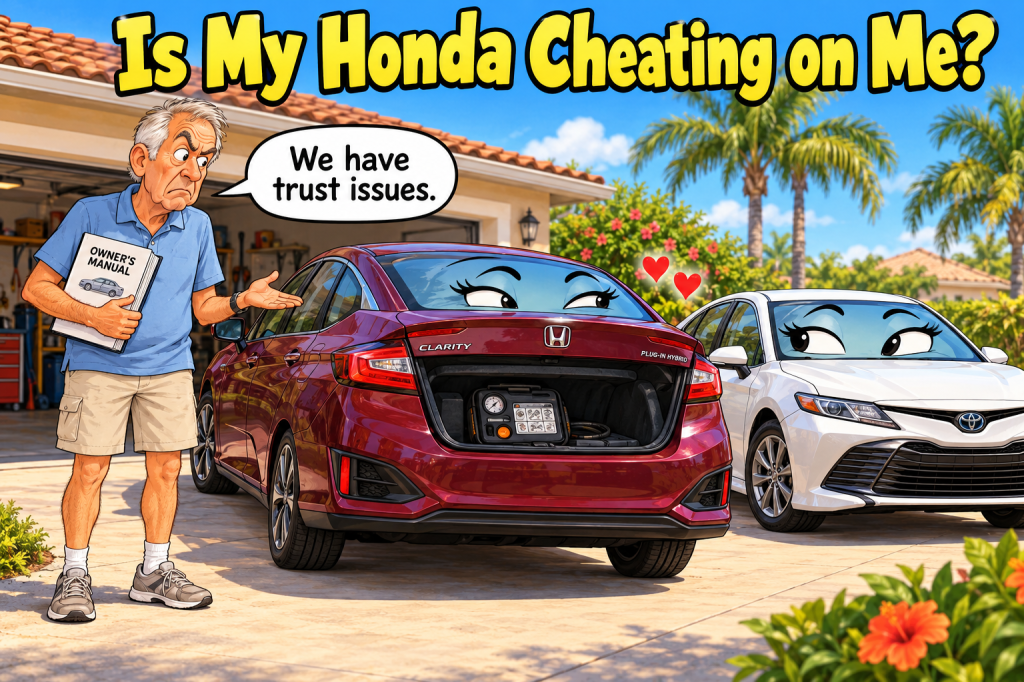
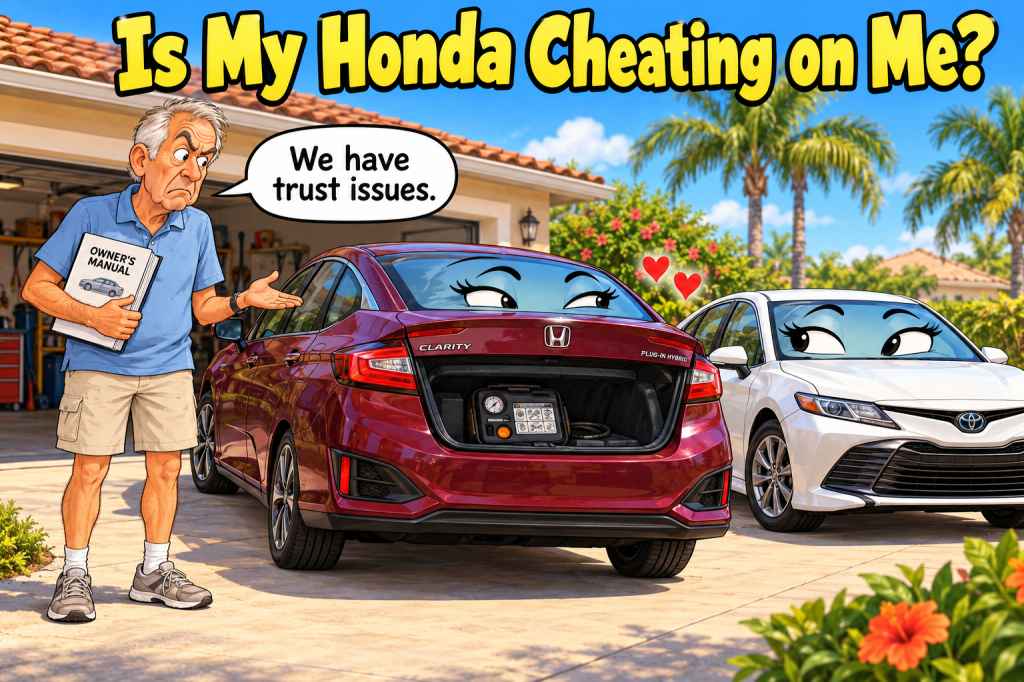
  • Is My Honda Cheating on Me?

    Is My Honda Cheating on Me?

    For more than 60 years, I’ve been driving all kinds of vehicles. Old, new, damaged, dirty. Some barely worth the gas in the tank.

    But one thing was almost always in excellent condition.

    The owner’s manual.

    Untouched. Unread. Practically suitable for resale.

    In all those years, I’ve opened one to check tire pressure, locate the spare tire, and find a place to stuff my registration and insurance card.

    Otherwise, it’s been a time capsule in the glove compartment.

    I don’t know how much time I have left on this earth, but I figured I ought to read an owner’s manual before I’m whisked off to my final destination.

    Preferably somewhere with valet parking.

    For years, I thought I understood the basic operating system:

    If something lights up red, pull over.

    If something lights up yellow, hope it goes away before the next oil change.

    Apparently, Honda had a more detailed plan.

    My Honda Clarity has features I’ve never used, settings I didn’t know existed, and buttons whose purpose I’ve never questioned.

    We’ve spent more than 100,000 miles together, and apparently we barely know each other.

    What’s it keeping from me?

    Is it cheating on me?

    I could care less if it’s winking and tooting at some cute Toyota.

    I know who’s coming home to my garage.

    Still, I decided to investigate.

    I felt like Geraldo Rivera in 1986, opening Al Capone’s vault. He found practically nothing.

    At least my glove compartment had an insurance card.

    I opened the manual.

    There are thousands of parts in this car. I’m familiar with about eight:

    Accelerator.

    Brake.

    Shifter.

    Power windows.

    Wipers.

    Air conditioning.

    Seat belts.

    And the steering wheel. Almost forgot that one.

    I’d include the emergency flashers if I could find the damn button.

    The investigation immediately became complicated.

    Apparently, Honda wrote the manual for people who already knew what everything meant.

    SRS: Supplemental Restraint System.

    Airbags.

    Why didn’t you just say airbags?

    “Supplemental restraint” sounds like something the nuns used after the regular restraint stopped working.

    TIN: Tire Identification Number.

    My tires have identification numbers?

    They already have more writing on them than my college diploma. Now I’m supposed to learn their identities?

    I’ve been calling them front left, front right, and the other two.

    TPMS: Tire Pressure Monitoring System.

    Finally. An old friend.

    That warning light has been on for so long I consider it part of the dashboard décor.

    I swear graduate engineers from MIT couldn’t figure it out.

    My method has been to get out and look.

    Apparently, Honda expects an actual pressure gauge.

    Another accessory to read about.

    Energy Flow Monitor.

    There’s a diagram showing where the power is coming from and where it’s going.

    Engine. Battery. Wheels. Little arrows.

    I thought pushing the accelerator settled that discussion.

    Now I’m supervising a utility company.

    Deceleration Paddle Selector.

    This lets you change how strongly the car slows down when you take your foot off the accelerator.

    The paddle I remember from third grade at St. Matthew’s accomplished much the same thing.

    Stopped me immediately.

    Then I discovered what appeared to be the Anti-DUI Package.

    Vehicle Stability Assist.

    Road Departure Mitigation.

    Collision Mitigation Braking System.

    Lane Keeping Assist System.

    Adaptive Cruise Control with Low-Speed Follow.

    The car can help keep me stable, help keep me in my lane, warn me about leaving the road, and help me avoid running into somebody.

    Of course, none of that makes it a designated driver.

    But it does raise a question.

    If my Honda knows how to do all this, why have I been doing all the work?

    Then there’s an acoustic alerting system so people can hear the car coming when it’s running quietly on electricity.

    Even my Honda has learned that sometimes you have to make a little noise to get noticed.

    We have that in common.

    By this point, I was running out of time.

    Not battery time.

    Earth time.

    I closed the manual. Whatever else my Honda was up to, it could keep to itself.

    I only wanted to settle one thing.

    Where was the spare tire?

    I looked it up.

    There isn’t one.

    Honda gave me a tire repair kit.

    More than 60 years of ignoring owner’s manuals, and the first time I finally read one, I discover the car has been withholding a tire.

    Forget the Toyota.

    We have trust issues.

    Read more stories at:  crazyfamily.blog 

  • Amtrak – 24 Hours for a 10 Hour Trip

    Amtrak – 24 Hours for a 10 Hour Trip

    I love Amtrak.

    I’m not exactly sure why.

    It seldom leaves on time and apparently considers its arrival time more of a suggestion than a commitment.

    I once had the option of traveling from Virginia to Williston, North Dakota. I could fly there in about three hours with one stop.

    Or I could take Amtrak.

    Forty-two hours.

    Seventy-eight stops.

    Virginia to Washington. Washington to Chicago. Chicago to Williston.

    Naturally, I took the train.

    Maybe Amtrak works for me because I’ve always needed to be moving. Even as a baby, I’d get on all fours in my crib and bang my head against the headboard.

    On Amtrak, I don’t even have to do that.

    I just sit there and the train provides the motion for the next 42 hours.

    Twice as Much Amtrak for the Same Price

    One February, I was traveling from Chicago to Williston. The trip was supposed to take about 12 hours.

    Somewhere along the way, the train hit a large rock on the tracks. The train bounced, smashed the front light, and suddenly our 12-hour trip was going to take closer to 24.

    The passengers in the lounge car were pissed.

    I tried to cheer everybody up.

    “Guys, look at it this way. You’re getting twice as much Amtrak for the same price.”

    Didn’t go over particularly well.

    Looking to Rekindle Your Romance?

    If you’re thinking about taking a romantic Amtrak trip to reignite your relationship, I have some advice.

    Don’t book a roomette.

    During the day, it’s actually quite nice. You sit facing each other, watching America roll by.

    It’s perfect for improving communication.

    Then night comes.

    The seats become beds.

    The lower bunk has roughly the headroom of two MRIs.

    The upper bunk has the headroom of one MRI.

    Whoever loses the coin toss gets the upper bunk.

    Now imagine waking up at 2:00 in the morning needing to use the toilet. You climb down something resembling monkey bars while the train rocks from side to side at 70 miles an hour.

    You may want to purchase travel medical insurance.

    Dinner With an Invisible Woman

    One of my favorite things about Amtrak is the community seating in the dining car. You meet fascinating people, and many of the employees have been riding the rails for 20 or 30 years.

    Whenever I meet someone who’s had an interesting job that long, I ask the same question:

    “What’s the craziest thing you’ve ever seen?”

    One longtime Amtrak employee didn’t hesitate.

    There was a passenger who always reserved two seats.

    But only one person ever showed up.

    He was traveling with his invisible wife.

    At every meal, he ordered for both of them.

    Two breakfasts.

    Two lunches.

    Two dinners.

    When his wife’s meal inevitably went uneaten, he’d say something like:

    “Honey, looks like you’re not going to finish that.”

    Then he’d ask for a to-go box and take her meal back to their room.

    Three meals a day.

    For a seven-day cross-country trip.

    I had only one question.

    Did she pay full fare?

    The Bleeding Samsonite

    I also have another piece of Amtrak advice:

    If at all possible, don’t check your luggage.

    Carol and I took the train from Florida to Savannah.

    We had made what we considered an excellent financial decision.

    Why pay Amtrak prices for glasses of Merlot and Chardonnay when we could bring our own?

    So we carefully wrapped bottles in paper towels and packed them inside our suitcases, surrounded by sweaters, slacks and underwear.

    What could possibly go wrong?

    At our departure station, I went to the restroom.

    While I was gone, Carol checked the bags.

    When we arrived in Savannah, a conductor built roughly like a sumo wrestler loaded the luggage onto a cart, rolled it onto the platform and began unloading it onto the concrete.

    Then our Samsonites hit.

    Click. Click.

    Oh, shit.

    We grabbed the bags and started rolling them toward the terminal.

    That’s when I noticed the blood.

    Red wine was leaking from a 26-inch Samsonite, leaving a trail and eventually a nice puddle in the middle of the station.

    I quickly rolled the patient into the men’s room and attempted to stop the bleeding.

    The Samsonite was in critical condition.

    Fortunately, security didn’t happen to walk through at that moment.

    Otherwise, explaining why my luggage was bleeding all over the Amtrak station might have resulted in a completely different kind of trip.

    All Aboard

    And yet, after all of that, I still love Amtrak.

    Because if you really want to see America, there’s nothing quite like it.

    By plane, you see America from gate to gate.

    By car, you see America from rest area to rest area.

    By train, you sit back and watch cities, farms, mountains, rivers and small towns roll past your window while somebody else worries about the driving.

    And occasionally you meet a man traveling across the country with his invisible wife.

    Just don’t worry too much about the schedule.

    If your 10-hour trip takes 24 hours, remember:

    You’re getting more Amtrak for the same price.

    All Aboard! 

    More stories?  Crazyfamily.blog 

  • Who the Hell Plays a Banjo?

    Who the Hell Plays a Banjo?

    Me…for 70 years.

    Apparently, it started when I was an infant. I’d get on all fours in my crib, rock back and forth, and bang my head against the front panel.

    The doctor told Mom this could be a sign of future musical ability and suggested trying an instrument when I got older.

    At six, Mom asked, “How would you like to take banjo lessons?”

    “Yeah, I guess. I don’t have much else going on. But can I finish Mighty Mouse first?”

    Mom and Dad loved Dixieland music from the ’20s and ’30s. She didn’t like guitars, so my musical future had already been decided.

    We finally found a banjo in a pawn shop. Even in the mid-’50s, people were hocking them. Today, you can hardly walk into a pawn shop without seeing two or three hanging in the back.

    Apparently, plenty of mothers had the same idea.

    By ten, Mom had signed me up for weekly half-hour lessons at $2.50 a session. I took the city bus—ten cents—from St. Matthew’s Grade School to Copp Music Center in South Bend.

    After three months, it was getting boring. Other kids were listening to the latest ’50s hits. I was trying to perfect “Let Me Call You Sweetheart.”

    My friends had rock ’n’ roll. I had their grandparents’ wedding music.

    I wanted to quit.

    Mom responded with my first entrepreneurial opportunity: she paid me a penny a minute to practice.

    An hour earned me sixty cents. In those days, that bought a lot of Tootsie Rolls.

    My musical passion suddenly returned.

    I kept playing through grade school talent shows and high school bus trips. Once I learned the school fight song, “Yankee Doodle Dandy,” and “Row, Row, Row Your Boat,” I had enough material to entertain a captive audience.

    And on a bus, they really were captive.

    Over the years, I learned a bunch of old Dixieland favorites, played parties, wrote and performed commercials, and composed company songs. One company even hired me to travel around the country entertaining and writing songs for their customers. 

    Mom’s penny-a-minute investment was paying off.

    One of my claims to fame was writing and singing a political fight song for a congressional candidate. He was so impressed that he had me travel throughout the district performing it at rallies.

    Then came Election Day.

    He lost by the biggest margin in Indiana history.

    I don’t put that one on my résumé.

    At Notre Dame, I was cited for playing the Notre Dame Victory March across campus after a few too many adult beverages.

    School spirit apparently had a volume limit.

    In Germany, I got kicked out of the Hofbräuhaus for playing my banjo while the oompah band was on break.

    The waitresses—the muscular ones who could carry eight mugs of beer at once—picked me up and carried me outside.

    I continued my performance beneath an apartment window.

    A woman on the second floor poured a bucket of water on me for waking up her kids.

    My first outdoor concert came with a complimentary shower.

    I’ve also played at dozens of assisted living facilities and nursing homes. My strongest market has always been the over-sixty crowd.

    Unfortunately, my audience keeps dwindling.

    And at seventy-five, I’m now part of my own target market.

    But my most memorable performance had nothing to do with politics, beer, or buckets of water.

    I was playing at a nursing home when I noticed the nurses were crying.

    What had I done?

    They told me one resident hadn’t communicated in any form for six months.

    When I played “Let Me Call You Sweetheart,” she started singing.

    The song I’d been so bored trying to learn as a kid had reached someone nobody else could reach.

    That one stayed with me.

    Of course, I don’t always keep things quiet. Sometimes I go into my version of Rod Stewart—jumping around, singing, and leading the crowd through the Hokey Pokey.

    After one particularly energetic performance, my sister’s high school friend asked her:

    “Has your brother always been like this?”

    I took that as a compliment.

    After seventy years, I’ve heard every banjo joke there is.

    “If you put a banjo and an accordion in a canvas bag and throw it off the Empire State Building, which one breaks first?”

    “Who cares?”

    Well, my banjo is still intact. It’s taken me across the country, gotten me thrown out of a German beer hall, helped a politician lose spectacularly, and brought a song back to a woman who hadn’t spoken in six months.

    It’s been a real fun run.

    And I still have a few Tootsie Rolls left.

    More stories at : crazyfamily.blog

  • No Complaintitis – A Serious Disease

    No Complaintitis – A Serious Disease

    I have been diagnosed with a rare medical condition called “No Complaintitis”

    The symptoms are alarming.

    I live in a retirement community in  Barefoot Bay, FL and I simply can’t find enough things to complain about.

    I love Barefoot Bay, and that’s the problem.

    Let’s review the evidence.

    Three swimming pools, a golf course. Pickleball, Tennis and Shuffleboard, miniature golf.

    A fishing pier stretching out over the Indian River where the sunsets are free every evening.

    Our own private beach access.

    Enough clubs and activities that I can’t even name them all. If there’s not a club for what you enjoy, someone will probably start one next Tuesday.

    The drinks are good and  inexpensive.

    Entertainment? They do  a terrific job coordinating events. Great bands, karaoke nights, dances, and activities seem to appear on the calendar faster than I can attend them.

    Hungry?  The food at the 19th Hole, Rustic Roast and Food Truck are great, making it even harder to complain.

    Then there’s housing.

    People spend two million dollars to live on the beach so they can enjoy the Florida sunshine.

    Here’s the funny part.

    We get the exact same sun.

    A typical Barefoot Bay home might cost around $200,000.

    For the price of one $2 million beach house, you could buy ten homes in Barefoot Bay…and probably still have enough left over to cover a few years of taxes, insurance, utilities, and maybe a few beverages at the lounge.

    Even better, those expensive beach houses don’t come with the built-in community that Barefoot Bay offers.

    Neighbors know your name.

    People wave.

    Someone is always organizing something.

    Someone is always willing to help.

    And all of this costs less than $1,200 a year in recreation fees—about $100 a month.

    I’ve spent more than that on golf balls.

    So here I sit searching desperately for something worthy of a complaint.

    Any suggestions?

    ⸻

    Many more stories at crazyfamily.blog

  • Congress:  What Are We Getting for Our Money?

    Congress: What Are We Getting for Our Money?

    If I invested $2 million in a business, I’d want to know what it was doing for its customers.

    So I have a question about Congress: What are we getting for our money?

    A typical U.S. representative earns a salary of $174,000. Add the average authorized budget to run the office, and the annual figure is about $2.1 million. For a senator, it is about $4.8 million. Most of that money pays for staff and official operations. It does not go into the member’s pocket. (everycrsreport.com⁠)

    That is a substantial public investment. What return should we expect?

    To me, the first responsibility is clear: represent the people back home. Constituents are the people who live in the district or state, including those who voted for someone else. They deserve an office that listens, responds, helps them navigate federal agencies, and brings their concerns into decisions in Washington.

    Members also have national responsibilities. They vote on legislation, serve on committees, and oversee federal agencies. Those duties can have a direct effect on the people they represent.

    But how does a member divide the day among all of it?

    Turn on the television and you may see a familiar face discussing the latest fight in Washington. Turn to another channel, and there’s another interview. Meanwhile, there are committee meetings, votes, constituent requests, and the continuing effort to raise money for the next election.

    I’m not suggesting an interview is automatically a waste of time. Explaining a vote or an issue can be part of the job. I am asking a question we cannot answer by counting the days Congress is in session:

    How much of a member’s time goes toward serving constituents, and how much goes toward building a national profile and getting reelected?

    There are two money systems here. Taxpayers fund the congressional office. Donors fund campaigns and political committees. Individuals and PACs can contribute to candidates within legal limits; Super PACs can raise unlimited amounts for independent political spending. That campaign money is separate from the office budget, but fundraising still makes a claim on a politician’s time. (fec.gov⁠, fec.gov⁠, fec.gov⁠)

    Representatives face reelection every two years. Senators serve six-year terms. Winning an election tells us who voters chose. It does not tell us whether someone who called the office got a response, whether a federal-agency problem was followed through, or whether local concerns were heard. (uscode.house.gov⁠)

    In business, I couldn’t tell my clients, “You’ll get a chance to review my performance in two years.” They’d tell me what was going wrong long before then.

    Why not ask constituents?

    I’d like each congressional office to publish an annual report on its work and invite independent feedback in years when its member is not on the ballot. Ask constituents straightforward questions:

    • Did the office respond when you contacted it?
    • If you asked for help with a federal agency, was the follow-up useful?
    • Does the member explain how national issues affect this district or state?
    • What local concern needs more attention?

    Publish the questions, how the survey was conducted, how many people responded, and the results. An open online poll could be a place to hear comments, but it shouldn’t be presented as the opinion of everyone in the district or state.

    Then tell us what the office intends to do with the answers.

    That seems like a reasonable request when we are investing millions of dollars a year in each office. We should be able to see the work, hear from the people it serves, and ask whether our representatives are giving those people enough of their time.

    After all, we’re the constituents. We’re also paying the bill.

    More stories…. Crazyfamily.blog

  • Online Dating – She Bit My Arm

    Online Dating – She Bit My Arm

    Carol and I folded our respective ex-spouses back into the community years ago. Then, at 68 and 75, we decided to find each other.

    But what do you do at our age?

    How many potential candidates are sitting at a bar waiting to connect with official Medicare-card-carrying strays?

    The library?

    There are probably a few possibilities left, but I haven’t read a book in ten years. What would I talk about?

    Church?

    Sure, there might be candidates, but they didn’t exactly fit my desired profile.

    So, like millions of other singles, I went online.

    Where Do You Start?

    Plenty of Fish. Match. OurTime. SilverSingles. Senior Singles. FarmersOnly. Christian Mingle.

    And about 400 others.

    I decided to start with one of the cheaper ones.

    It proved to be cheap.

    They all start about the same: Male. Height: Tall. Build: Slim, athletic, average or a few extra pounds. Picture. Likes. Dislikes. Hobbies. What are you looking for?

    I filled it all out.

    For the record, my build is average — without my beer belly.

    Let the Dating Begin

    Plenty of Fish: $29.95 on the Visa.

    Online dating quickly becomes a full-time job.

    You reach out to dozens of people. The ones you like don’t respond. The ones you don’t like flood your inbox.

    My age put me into the “few extra years” category.

    Slim pickings based on my desired profile, but my inner child kept reminding me:

    You’re in your mid-seventies!

    I was looking for a woman of average build who loved romantic cruises on a lake at sunset, cozy nights by the fire, traveling and trying new restaurants.

    I got my first hit.

    She loved nighttime cruises, too.

    Through marshland looking for good places to catch walleye.

    Then she’d get up at 5 a.m., bait the hooks and spend four hours enjoying the hot sun and feeding mosquitoes.

    Cozy evenings?

    Absolutely.

    Watching Jeopardy! reruns.

    Travel?

    Four times a year to Poughkeepsie to visit the grandchildren.

    “Billy is a junior and third-string running back. Maybe you could join us for our October trip. We’re hoping to see him get across the line of scrimmage at least once before Grampy dies — or Billy graduates.”

    This wasn’t going to be the one.

    Then She Bit Him

    Next, I connected with a woman who seemed to have everything I wanted and more.

    We arranged our first date at a bar.

    Everything was going great. Talking. Laughing. Shots. Karaoke. Cuddling in a booth.

    This could be the one.

    Then suddenly:

    “Oh, shit. My ex-boyfriend is here. We shouldn’t have come here. This is the biker bar he hangs out at.”

    Wonderful.

    Am I about to become a bumper sticker on the mirror behind the bar?

    He walked over.

    “Are you dating her?”

    “Nope. First time.”

    He nodded.

    “You better be careful.”

    Then he pulled up his sleeve and pointed to several marks on his arm.

    “These are all the places she bit me.”

    Nope. Not the one.

    Maybe I Needed a Better Dating Site

    I moved up to the next level and decided to test the lower age ranges.

    50+.

    A long shot.

    Hopefully she wouldn’t do the math.

    When this 50-year-old reached retirement age at 67, I’d be 92, sitting at Happy Acres Rest Home eating creamed corn, Jell-O, applesauce and prunes.

    Then I got a hit.

    Beautiful Asian woman from Singapore. Late 40s. Slim. Great smile. Smart. Very friendly.

    She told me in her culture the man was the head of the household and her role was to pamper and fill every need of  her soulmate until death do us part.

    “You are what I dreamed of. We have so much in common.”

    We communicated day and night for weeks.

    Soon, we were in love.

    Finally!

    I had found my life partner.

    She couldn’t stand being away from me any longer and decided to buy a one-way ticket to Orlando.

    Cost: $965.

    Then came a little problem.

    “My brother owes me money, but he can’t pay me until he sells his motorcycle.”

    Could I cover the airfare?

    Of course, she did love me and would certainly pay me back.

    “How do I send it?”

    Easy.

    Buy gift cards and text her the numbers.

    Nope.  She certainly wasn’t the one.

    My beautiful future bride from Singapore disappeared about as quickly as she had appeared.

    Watch out for this scam.

    Surely my luck had to improve.

    One More Try

    Next came a beautiful woman, 65, athletic, 5’8”, no baggage, no kids, no cats, no dogs, no grandkids and no debt.

    She raved about her experience in fine dining, French wine, white tablecloths, candles and Baked Alaska for dessert.

    She lived 50 miles away.

    Perfect.

    We planned dinner, drinks, a piano bar and maybe dancing.

    Then she walked in.

    If that was really her profile picture, it had been taken about 35 years earlier.

    Apparently, I’d fallen in love with a historical photograph now dressed in an aqua colored house coat. 

    She spent most of dinner guzzling imported wine and working her way through four baskets of warm rolls and several helpings of tenderloin.

    At one point, I excused myself, walked into the men’s room and slammed my head against the hand dryer.

    When is this going to be over?

    The $6.50 Rule

    After all my online dating experience, I can offer one valuable piece of advice:

    ALWAYS MEET AT STARBUCKS THE FIRST TIME.

    Invest 30 minutes and $6.50 on a large Caramel Frappuccino.

    If there’s nothing there, you’ve lost half an hour and the price of a coffee.

    If there is?

    Move on from there.

    Or maybe move in.

    Then There Was Carol

    Carol and I actually did meet online.

    We had both reached the same conclusion at about the same time:

    One more try.

    We happened to both sign up for the most expensive dating site. 

    And this time, it worked.

    No walleye.

    No bite marks.

    No Singapore gift cards.

    No 35-year-old glamour shots.

    Just Carol.

    We got married July 18, 2026.

    So maybe online dating really does work.

    It just took several bad dates, one scammer and a woman whose ex-boyfriend had teeth marks on his arm to prove it.

    What happened after online dating?

    Carol and I got married—and I danced down the aisle at 75. [Read our wedding story.]

    At 75, I Got Married. We Threw Out the Wedding  Rulebook.

    https://crazyfamily.blog/2026/08/17/date-an-undesirable-see-the-world/

    Many More Stories ….crazyfamily.blog

  • Our Mission Statement Plaque Is Now a Coat Rack

    Our Mission Statement Plaque Is Now a Coat Rack

    Insanity: The Corporate Mission Statement

    For 25 years, Acme Industrial Machine Tool Company had been remarkably successful. Sales grew almost every year, we regularly exceeded our revenue goals, management worked well together and—believe it or not—departments actually communicated.

    We had assembled a good team, people knew their jobs and the company ran like a well-oiled machine.

    Obviously, something had to be done about that.

    It Started at a Conference

    Our CEO attended the annual Industrial Machine Tool Association Conference in Scottsdale, Arizona.

    You know these conferences. Educational sessions mixed in with golf, tennis, pools, spas, cocktail hours and expensive dinners.

    Most attendees claimed they were there to learn about the latest industry trends. Others saw it as an opportunity to get away from the office, screaming kids and the spouse for a long weekend subsidized by the IRS.

    Our CEO made the mistake of actually attending one of the educational sessions:

    The Steps to Developing Your Corporate Mission Statement.

    The presenter was a consultant and, naturally, a world-renowned expert on corporate mission statements. He had charts, impressive credentials, testimonials and, most importantly, business cards.

    Our CEO brought one home and made the call

    Let the games begin.

    Apparently, We Didn’t Know Why We Were in Business

    The consultant arrived and spent several days interviewing management and touring the company. He wanted to know who we were, what we did, why we did it, where we were going, who our customers were and what made us different.

    These were apparently questions we had neglected to ask during our first 25 successful years.

    Soon we were discussing paradigms, synergies, core competencies, customer touchpoints and stakeholders.

    I never quite understood stakeholders.

    I thought they were the guys directing traffic at construction sites.

    Eventually, the consultant presented his plan to help us discover our corporate purpose.

    $75,000. Plus expenses.

    For $75,000, we were finally going to discover why we existed.

    Mission Statement Day

    More than 100 employees were summoned to a local convention hotel and divided into teams. The room was filled with flip charts, easels, markers, index cards, masking tape and enough Post-it notes to wallpaper Rhode Island.

    The consultant explained that we were about to embark on a journey to discover our corporate purpose.

    He started with a seemingly simple question:

    Why does Acme exist?

    “To make machine tools.”

    Apparently wrong.

    “To sell machine tools.”

    Also wrong.

    “To make money.”

    Definitely wrong.

    It turned out we weren’t actually selling machine tools. We were providing solutions, experiences, relationships and value.

    Who knew?

    For 25 years we’d been foolishly shipping machinery.

    Creating the Masterpiece

    Each table was instructed to develop its own ideas for a Mission Statement.

    That’s when normal English disappeared.

    People who had arrived that morning speaking perfectly understandable sentences were suddenly talking about empowering employees, leveraging technology, embracing innovation and maximizing stakeholder value.

    Someone suggested we needed to “synergize our core competencies.”

    I wasn’t sure whether that was legal.

    The consultant loved it.

    At the end of the day, he collected our flip charts, Post-it notes and accumulated corporate wisdom. Then came more meetings, drafts and revisions.

    Should we say customers or business partners? Improve or optimize? Work together or collaborate?

    Apparently, civilization hung in the balance.

    Finally, after months of work and $75,000, the CEO called everyone together.

    This was it.

    He proudly unveiled our new Corporate Mission Statement:

    “Our mission is to dynamically synergize next-generation paradigms, empowering disruptive ideation to holistically optimize consumer touchpoints and to develop a successful aforementioned entity with honesty, integrity and collaborative partnerships with customers, employees, suppliers, leadership and our stakeholders.”

    There it was.

    After 25 years, we finally knew why we existed.

    I still didn’t know what an “aforementioned entity” was.

    Living the Mission

    Every employee received a laminated wallet-sized card containing the Mission Statement. The CEO encouraged us to carry it, read it every morning and use it as a guide when making our daily decisions.

    A huge, heavy plaque containing the statement was mounted prominently on the wall behind the receptionist. Customers, suppliers and visitors couldn’t enter the building without seeing what Acme stood for.

    It was impressive.

    For about a month.

    Then Christmas arrived.

    Someone hung a wreath on the plaque. Garland and ornaments followed. Before long, you couldn’t read our $75,000 Mission Statement without moving Santa Claus.  It also proved valuable in decorating all holidays.

    The plaque also turned out to be a convenient place to hang coats.

    The laminated cards found even more practical uses. Employees used them to scrape ice off windshields, remove dried coffee from desks and occasionally pick lunch out of their teeth.

    Apparently, we had finally found some tangible benefits from the Mission Statement.

    Meanwhile, Acme kept doing what it had been doing for the previous 25 years: selling machine tools, taking care of customers and making money.

    In our 26th year, we more than achieved our annual revenue goal, continuing our long record of growth.

    There was only one problem.

    Our net income came in $75,000 below forecast.

    Go figure.

    More reading….

    Unlimited Leads Promised, They gave me a phone book

    https://crazyfamily.blog/2026/09/09/unlimited-leads-promisedthey-gave-me-a-phone-book/

  • “Here’s Your Co-Pay. No, Actually, You Pay.”

    “Here’s Your Co-Pay. No, Actually, You Pay.”

    I’ve spent 50 years in business. I have a BBA and an MBA. I’ve read contracts, financial statements, purchase agreements and enough fine print to permanently damage my eyesight.

    Then somebody handed me a health insurance policy.

    I didn’t understand a damn thing.

    Apparently, the health insurance industry decided healthcare wasn’t complicated enough. So they invented their own language.

    Office Visit

    I’ve visited friends.

    I’ve visited relatives.

    I’ve even visited France.

    Doctor Office visit? 

    Thanks for visiting. That’ll be $175.”

    Deductible

    Now there’s a word I recognized.

    I’ve been doing tax returns for 50 years.

    Mortgage interest? Deductible.

    Business expenses? Deductible.

    Charitable contributions? Maybe deductible.

    So when my health insurance company said I had a $2,500 deductible, I thought:

    Great. Where do I put it on my tax return?

    Apparently, that’s not what deductible means.

    I got audited

    It means I pay the first $2,500.

    Why didn’t they just say that?

    Co-Pay

    This one sounded encouraging.

    “Co” means we’re doing this together.

    Like co-worker. Co-pilot. Co-owner.

    So who’s my co-payer?

    Apparently, me.

    I go to the doctor and pay $40.

    Specialist? $75.

    Urgent care? $100.

    Emergency room?

    At this point, I think we should eliminate the confusion and rename it:

    I-Pay.

    Coinsurance

    Wait I already bought insurance.

    Now I need insurance for my insurance?

    Not exactly.

    Coinsurance means that even after I pay my deductible, I may still pay a percentage of the bill.

    The insurance company might pay 80%.

    I pay 20%.

    So I pay a premium so I can have insurance.

    Then I pay the deductible so I can use the insurance.

    Then I pay coinsurance after I’ve used the insurance.

    Networks 

    In-Network

    This means your doctor has an agreement with your insurance company.

    Good.

    Out-of-network means your doctor doesn’t.

    Not so good.

    The problem is figuring out who’s in which network.

    Your doctor may be in-network.

    The hospital may be in-network.

    The anesthesiologist who appears for 11 minutes while you’re unconscious?

    Good luck.

    Prior Authorization

    Here’s another beauty.

    Your doctor examines you and decides you need a test.

    But before you can have it, the insurance company may want to decide whether you need it too.

    Apparently, medical school is no longer enough.

    You also need permission from someone you’ve never met.

    Explanation of Benefits

    After all this, the insurance company sends you an EOB — Explanation of Benefits.

    Across the top, in large letters, it says:

    THIS IS NOT A BILL.

    Then it contains:

    Amount billed: $4,850

    Allowed amount: $2,375

    Plan paid: $1,420

    Your responsibility: $955

    Naturally, you spend the next 20 minutes trying to figure out:

    If this isn’t a bill, why are you telling me I owe $955?

    Now Compare the Plans

    This is where health insurance reaches its full potential.

    Plan A has a lower deductible but a higher premium.

    Plan B has a lower premium but higher coinsurance.

    Plan C has better prescription coverage but your doctor isn’t in the network.

    Plan D has a $7,500 out-of-pocket maximum, unless something doesn’t count toward the out-of-pocket maximum.

    So you finally ask the insurance agent the only question that matters:

    “Which plan gives me the best coverage at the lowest price? 

    And the answer is basically:

    “How sick are you planning to be next year?”

    That’s the problem.

    You’re choosing insurance today based on diseases, accidents, prescriptions, specialists, MRIs and emergency-room visits that haven’t happened yet.

    What the Hellth! 

    You can’t make this stuff up.

    More reading at Crazyfamily.blog

    At 75, I Went to the Hospital. The Confusion Started Immediately.

  • Unlimited Leads Promised?They Gave Me A Phone Book

    Unlimited Leads Promised?They Gave Me A Phone Book

    Anyone who spent time on a sales team years ago can probably relate to the insanity of the old sales process. I’ve been in sales and management for 50 years, and I’ve seen enough of it to know one thing:

    You can’t make this stuff up.

    Telemarketing

    Most salespeople want to maximize their income as quickly and easily as possible. That’s why those ads always sounded so good:

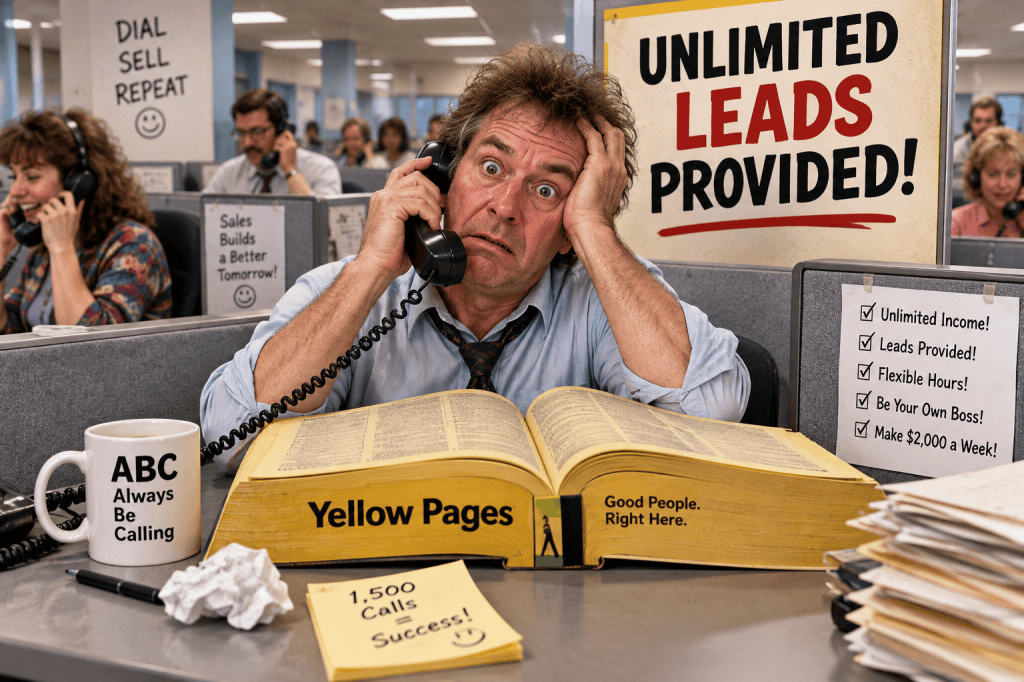
    Unlimited income! Leads provided! Several openings!

    Part-time or full-time! Make over $2,000 a week!

    Click here for an immediate interview.

    There was just one little detail:

    No base salary.

    You showed up and discovered a boiler room packed with people on phones, squeezed into cubicles about the size of an airplane restroom. Your training lasted approximately an hour.

    Then they gave you the secret to sales success:

    ABC — Always Be Calling.

    The income projection looked terrific: “Make 1,500 calls a week and you could make $1,500 in your first 90 days.”

    Great. Who do I call?

    “Start with your family. In-laws. Church members. Godparents. Friends. Neighbors.”

    Perfect.

    Soon conversations like this were taking place all over town:

    “Honey, Gordon called. You know, Bill and Mary’s son next door? He has a new job selling Aqua Osmosis Water Filters.”

    “We already have a Culligan water filter.”

    “Yes, but Gordon says ours isn’t Osmosis.”

    “So?”

    “I think we should buy one anyway.”

    “Why?”

    “Well, Bill and Mary bought 25 boxes of Girl Scout cookies from Melody every year for ten years. It helped pay for her trip to Washington.”

    “How much is this thing?”

    “Only $299. And it comes with a lifetime warranty.”

    “Really?”

    “Yes…as long as you have the original packaging, receipt,  bar code, serial number, store name and salesperson’s name and home phone number, and agree to pay shipping both ways.”

    OMG.

    After 1,500 dials, you had called every friend, relative and person who had ever made the mistake of giving you their phone number. Maybe you generated 25 warm leads.

    Then you became exhausted, dizzy and quit.

    Then, of course , those 25 warm leads were moved upstairs to the “recruiting team” where they were divided up. 

     But wait the advertisement said :

    LEADS PROVIDED 

    When somebody finally asked where these unlimited leads were they handed him a phone book. 

    It was the old throw tomatoes against the wall and see what sticks strategy.

    The company wasn’t really in the sales business.

    It was in the recruiting business.

    With no base salary, you were just another tomato.

    The Corporate Sales Team

    Then there was the Monday morning sales meeting.

    I can still see it: a giant whiteboard across the front of the room with columns and rows for every salesperson.

    “Okay, Joe. Another week. How many calls?”

    “Five hundred.”

    “How many doors?”

    “Seventy-five.”

    The sales manager shook his head. “You’ve got to increase your activity.”

    Apparently, 500 phone calls and 75 doors weren’t enough.

    Then came the motivation.

    “Remember our 2026 planning meeting? You promised your wife you were going to make Platinum Club and buy her a Mercedes.”

    Nothing motivates a salesperson quite like having management remind him of a promise he made to his wife.

    “Don’t you want to make Platinum?”

    Of course you did.

    Platinum meant walking across the stage at the national conference. Applause. Lights. Glitter. A photograph shaking hands with the CEO.

    And finally, your magnificent 6-by-6-inch engraved plaque to hang proudly over the fireplace.

    Someone in purchasing anonymously revealed that the plaques cost $5.99 each when ordered in lots of 1,000.

    But keep making those calls, Joe.

    “At your current pace, you’re looking at a 2019 Honda Accord with 130,500 miles from Budget Rent A Car.”

    Then the manager moved down the whiteboard.

    “Mary Ellen, did you ever get an appointment with Sam Jenkins, president of Acme Manufacturing?”

    “No. I still can’t get past the gatekeeper.”

    “Have you been dropping off sweets like we discussed?”

    Mary Ellen looked exhausted.

    “For 35 weeks I’ve dropped off donuts, and now the office manager is blaming me for her diabetes.”

    Such was the glamorous life of the professional salesperson.

    And sales wasn’t merely battling customers. We battled everybody.

    Production was furious because we promised the customer a delivery date they said was impossible. Finance questioned the expensive dinner that helped land the multimillion-dollar order.

    Purchasing complained, “They sold all this stuff, and now we have to order it, expedite it and get it delivered. Damn salespeople.”

    Meanwhile, somebody in top management was usually saying, “They have no idea what they’re doing down there.”

    One day, after hearing enough complaints about the sales department, my boss—the Senior Vice President of Sales—finally put everything into perspective.

    “No matter what anybody around here says about the sales team, remember one thing.”

    Then he gave me perhaps the greatest sales lesson of my 50-year career:

    NOTHING HAPPENS TILL YOU SELL SOMETHING.

    More stories. Crazyfamily.blog


    https://crazyfamily.blog/2026/08/27/business-insanity-youve-been-promoted-and-took-a-75000-pay-cut/