Going to the emergency room used to be simple.
You walked in and said:
“I’m sick.”
Someone looked at you and said:
“Okay. Sit down.”
Not anymore.
Today, before anyone determines whether you’re actually going to live, you have to survive Registration.
First Emergency: Registration
You walk up to the desk.
“Name?”
“John.”
“Date of birth?”
I give it to her.
“Address?”
I give her that.
“Insurance?”
Hand over the card.
Then the questions begin.
Emergency contact?
Primary doctor?
Pharmacy?
Medications?
Allergies?
Previous surgeries?
Religious preference?
Living will?
Power of attorney?
At this point, I’m expecting:
“Who was your third-grade teacher, and what was the name of your first dog?”
Then they hand you an electronic pad.
“Sign here.”
I sign.
“Here.”
Sign.
“Here.”
Sign.
After approximately 100 signatures, I finally ask:
“What exactly am I agreeing to?”
Apparently, everything.
Treatment.
Insurance.
Billing.
Privacy.
Release of information.
And something called HIPAA.
HIPAA
HIPAA is designed to protect your medical privacy.
Apparently, before HIPAA, hospitals were just wandering around telling everybody:
“Hey, did you hear what Voll has?”
Now they can’t tell anyone anything.
Including, occasionally, you.
I picture a courtroom.
“Mr. Voll, how do you plead?”
“Not guilty.”
“Your Honor, due to HIPAA regulations, we’re unable to tell the defendant what he’s charged with.”
“Excellent. Proceed.”
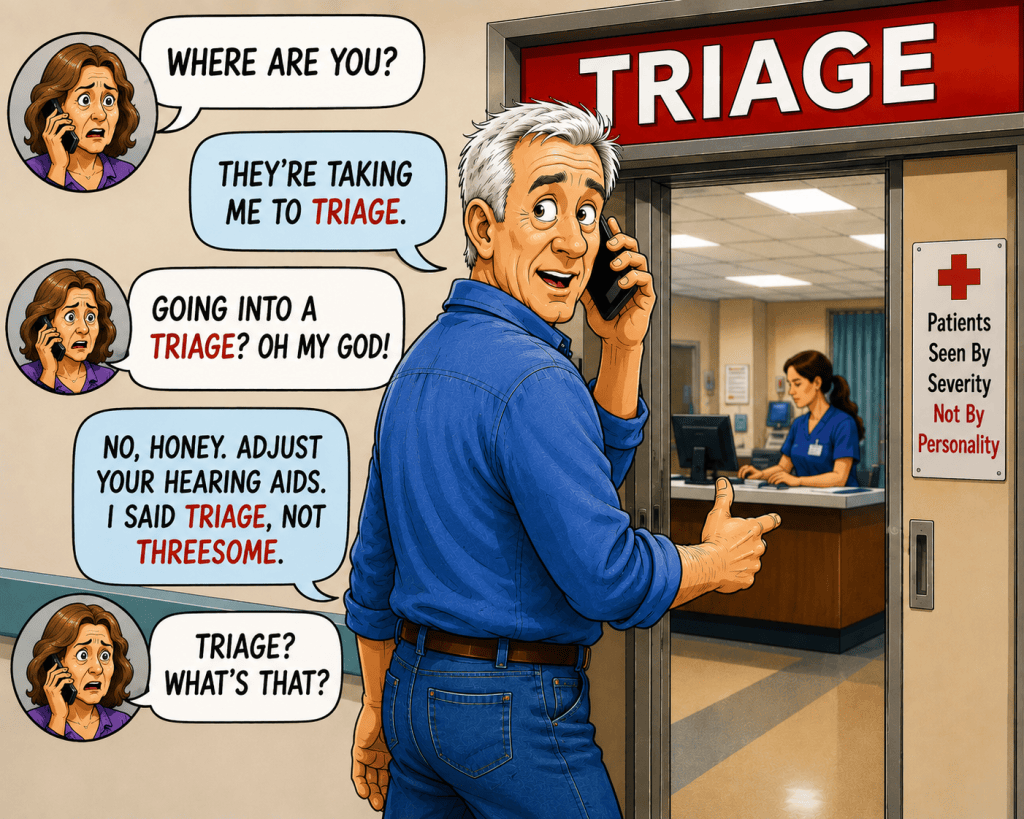
Then I Was Invited to a Triage
Eventually, a nurse came out and said:
“Mr. Voll, we’re ready for your triage.”
My what?
At 75 years old, I thought I had heard just about everything.
Apparently not.
I looked around.
There was a nurse.
There was me.
I wasn’t sure who the third person was supposed to be.
Then I realized she said triage.
Not threesome.
That was disappointing.
A triage, I discovered, is where they determine how quickly you need medical attention.
Blood pressure.
Temperature.
Pulse.
Oxygen.
Symptoms.
Pain level.
“When did this start?”
“How severe is your pain from one to ten?”
That’s always an interesting question.
What does 10 mean?
Shark attack?
Kidney stone?
Notre Dame losing to USC?
Give me some parameters.
Now Let’s Talk Insurance
Eventually you enter another branch of modern medicine:
Health insurance vocabulary.
Office visit.
Co-pay.
Deductible.
Co-insurance.
Out-of-pocket maximum.
EOB.
An EOB is an Explanation of Benefits.
Which is interesting because after reading one, I generally need someone to explain the Explanation of Benefits.
The hospital charges $8,000.
The insurance company says it’s worth $1,700.
They pay $1,100.
You owe $347.62.
And apparently $4,852.38 simply disappears into the same place as unmatched socks.
Then there’s the out-of-pocket maximum.
That sounds reassuring.
Until you discover your pocket apparently extends all the way down to your ankle.
Medical People Also Speak in Code
Doctors and nurses love abbreviations.
BP.
EKG.
CBC.
MRI.
CT.
ENT.
GI.
ICU.
ER.
PCP.
After a while, you begin wondering whether you’ve entered a hospital or bought a vowel on Wheel of Fortune.
Then the doctor walks in and says something like:
“Your CBC looks okay, but I’d like a CMP, maybe a CT, and we’ll follow up with your PCP.”
I nod intelligently.
“Absolutely.”
I have no idea what he just said.
But at my age, I’ve learned something important:
When a doctor uses more than three abbreviations in one sentence, just nod.
 You Cant Make this stuff up
Leave a comment