Tag: business

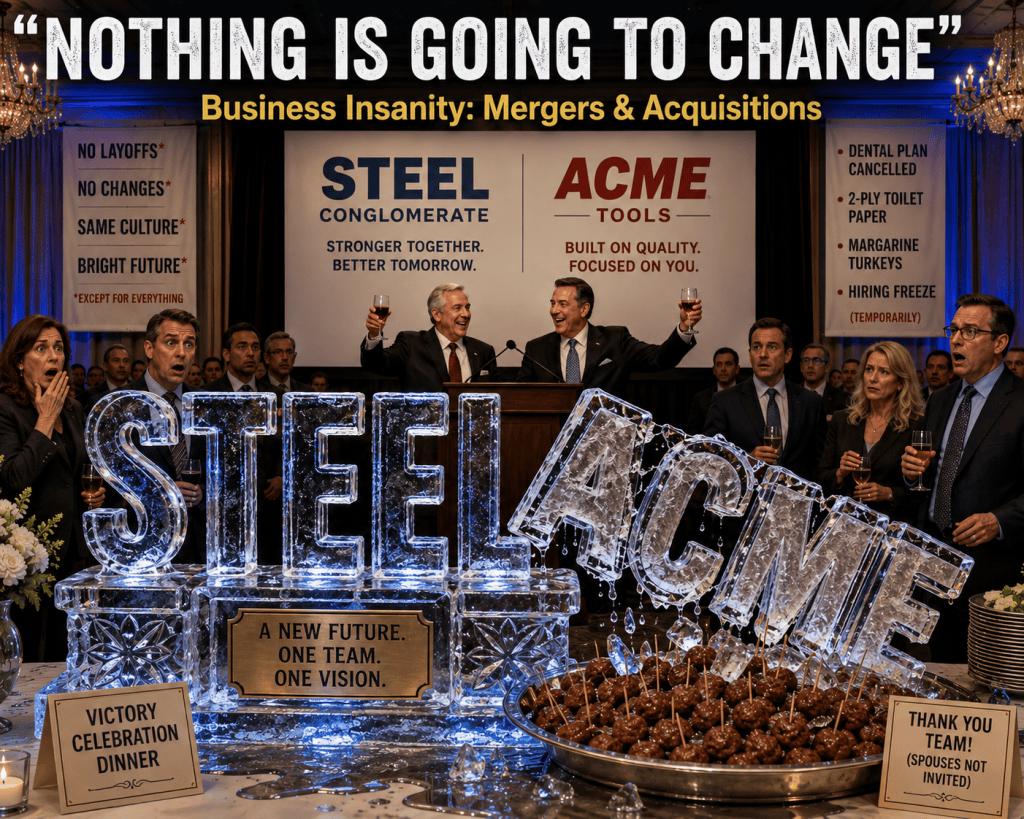
  • Business Insanity: Mergers & Acquisitions — “Nothing Is Going to Change… Right?”

    I’ve been through the merger-and-acquisition rodeo three times.

    Different companies. Different executives. Different buyers.

    Same script.

    First, a quick definition.

    A merger is when two companies combine to form one business. Ownership, operations, employees, assets and customers may all be combined.

    An acquisition is when one company buys another company—or substantially all of its assets.

    The difference is important.

    Especially when you’re the company being “merged.”

    Step One: The Strategic Plan

    It begins with the Board of Directors and senior leadership disappearing to some remote location for a strategic planning retreat.

    The mission:

    Develop our three-to-five-year growth plan.

    Every department presents:

    ● Short- and long-term goals

    ● Revenue and profit projections

    ● Staffing and capital requirements

    ● A beautiful PERT chart showing exactly how we’re going to get there

    Eventually, all the numbers are combined.

    Revenue goal: $1.5 million.

    The number is announced to the employees.

    Posters go up.

    Charts appear in conference rooms and throughout the shop.

    Everybody is told:

    This is our future.

    Let the games begin.

    Step Two: The Other Strategic Plan

    About a month later, the Board and senior leadership meet again.

    This meeting is different.

    No posters.

    No employee participation.

    No inspirational banners.

    CONFIDENTIAL.

    The Chairman begins:

    “Our industry is expanding, and we have an opportunity to investigate a possible merger or acquisition.”

    Then comes the magic sentence:

    “This could be very lucrative for all of you.”

    Senior management will receive company stock as part of their bonuses.

    If the deal goes through, those shares could eventually be worth five or six figures.

    To get there we need to significantly increase our bottom line with higher revenue and significant cost savings. 

    Suddenly, the strategic plan we spent months developing needs a few minor adjustments.

    Revenue goal?

    Raise it from $1.5 million to $1.9 million.

    Staffing plan?

    Hiring freeze.

    Including those expensive skilled people we’ve spent the last two-and-a-half years recruiting because we supposedly needed them to hit our long term growth targets.

    “We can get to $1.9 million by squeezing the players we already have.”

    Translation:

    Full-court press.

    Then each department is asked to identify its expensive employees.

    Mr Milton ll, recently filled the position of VP of sales with his son Milton lll.   Other Southeastern Mid States College graduates with Arts and Letters degrees are being considered for other high level positions. 

    Benefits?

    Cancel the company dental plan.

    Cost reductions?

    Switch to two-ply toilet paper.

    Thanksgiving turkeys?

    Butterball is out.

    Margarine-brand Walmart turkeys are in.

    Everybody pushes harder.

    People work longer.

    The troops are driven to the brink.

    And guess what?

    It works.

    Revenue jumps.

    Profits climb.

    The company’s valuation increases.

    And those stock options held by senior leadership suddenly look very attractive.

    Time to Tell the Troops

    All employees are paraded into the local IMAX theater to hear about their exciting future on the big screen.

    Apparently, a normal conference room isn’t large enough to contain this much excitement.

    The CEO takes the stage.

    “Fellow Acme Tools team members, we have an exciting announcement.

    “We have been holding discussions with Steel Conglomerate regarding a potential merger.

    “Their financial resources, technological leadership and skilled employees perfectly complement our mission and goals.

    “This combination will create tremendous opportunities for everyone.

    “And we want to assure you that nothing is going to change.”

    Questions?

    “Will there be layoffs?”

    “No plans for layoffs.”

    “Will management change?”

    “Both companies will be equally represented.”

    “Will our operating style change?”

    “Absolutely not.”

    “Dress code?”

    “No change.”

    “Benefits?”

    “No changes.”

    Pause.

    “Well, except we’re temporarily eliminating the dental plan.”

    Someone raises a hand.

    “Can we at least switch back to Butterball instead of margarine  turkeys?”

    Another employee:

    “And maybe better toilet paper?”

    The CEO smiles.

    “Those items are on the agenda for next month’s Board meeting, after we review the numbers.”

    Excellent.

    Our corporate future is secure.

    Toilet paper is under Board review.

    Let the Culture Wars Begin

    Within days, the really important merger issues emerge.

    Whose office is bigger?

    Who gets the river view?

    Whose title survives?

    Who reports to whom?

    Which company’s procedures are now “standard”?

    Whose computer system gets dumped?

    And, most importantly:

    Whose boots should you start licking if you want to get ahead?

    Bedlam.

    But management remains confident.

    Remember:

    Nothing is going to change.

    The Victory Dinner

    Then comes the grand merger celebration.

    Employees are invited.

    Spouses and significant others are not.

    “Sorry. Not enough room.”

    In the center of the ballroom is a magnificent ice sculpture displaying the name of our newly merged company:

    STEELACME

    Beautiful.

    Behind the stage are the two company names:

    STEEL

    CONGLOMERATE

    and

    ACME

    TOOLS

    The two co-CEOs take the stage and deliver inspiring speeches about partnership, equality, one team, one vision and our exciting shared future.

    Then something happens.

    The ballroom is warm.

    The ice begins to melt.

    And shortly after the co-CEOs finish speaking, the ACME portion of the sculpture starts leaning.

    Then cracking.

    Then sliding.

    Finally, the entire ACME section breaks loose and crashes directly into the tray of toothpick-stabbed meatballs.

    Everyone stares at what remains standing:

    STEEL

    Apparently, the ice sculpture knew something we didn’t.

    Our merger had just become an acquisition.

    Leadership’s stock?

    Booming.

    Dental plan?

    Gone.

    Butterball turkeys?

    Gone.

    Good toilet paper?

    Still under Board review.

    But don’t worry.

    Management promised us:

    Nothing is going to change… Right?

  • Business Insanity – “Welcome to Management – That’ll Cost You $75,000”

    Congratulations! You’ve Been Promoted — And Took a $75,000 Pay Cut

    There are few words more dangerous in corporate America than:

    “We see you as management material.”

    Our sales manager, Bill, had been around for 25 years. He knew the customers, knew the products, knew the salespeople and, most importantly, knew which salespeople needed encouragement and which needed a swift kick in the rear.

    Bill was good. Maybe too good.

    One day, the Senior Leadership Team — otherwise known as “They” — gathered in the conference room.

    The stakeholders weren’t getting the return on investment they expected.

    Translation:

    Somebody had to go.

    Out came the flip charts and Magic Markers. Somebody listed the highest-paid employees.

    There was Bill.

    After 25 years of helping build the company, Bill was offered an early-retirement package.

    Fortunately, Bill was delighted. He took the money and headed off to travel with his wife.

    Now management needed a replacement.

    Everybody knew Mark was the obvious choice.

    Mark was the company’s heavy hitter. Top producer. Great with customers. He had even mentioned a few years earlier that someday he’d like to move into management.

    Corporate remembered.

    “Mark, this is a fantastic opportunity. It’s your pathway to the C-suite.”

    No more prospecting. No more cold calls. No more chasing customers.

    Instead, he’d be recruiting, training and providing leadership.

    There was just one small detail.

    Mark’s current compensation:

    $40,000 salary

    $125,000 average commission

    Total: $165,000

    His exciting new management opportunity:

    $60,000 salary

    Up to $30,000 bonus

    Maximum: $90,000

    Mark accepted the position to initiate his climb up the corporate ladder and somehow landed $75,000 closer to the ground.

    But there was more.

    His customers became house accounts.  “They” were thrilled.  No more commissions and they filled the position. 

    Instead of selling, he was now recruiting salespeople, training them, babysitting them, firing them, sitting through business reviews and explaining to senior management why Joe only made 500 calls last week.

    Weekends?

    Management meeting.

    Evenings?

    Salesperson emergency.

    Monday morning?

    Improvement plans.

    And if the team missed its number, Mark got to explain why.

    After a few months, Mark decided the C-suite wasn’t quite as attractive as advertised.

    So Mark did what corporate America occasionally describes when somebody disappears:

    He folded himself back into the community.

    Except Mark folded himself directly into a competitor — along with 20 years of industry experience and half his customer relationships.

    So What’s Next?

    Not to worry.

    The Senior Leadership Team immediately began an exhaustive nationwide search for the most qualified replacement.

    After careful consideration, they unanimously selected the CEO’s grandson, Milton III.

    Milton had just received his bachelor’s degree in Community Service from Southwestern Mid-States University and brought extensive sales experience to the position.

    He had been named the 3rd Quarter, Top Door-to-Door Salesperson for Cutco Knives.

    The announcement went out companywide:

    “Please join us in welcoming Milton III, our new Vice President of Sales.”

    And somewhere across town, Mark was having the best sales month of his career.

  • “Who’s Going to Make This Stuff?” America has $2 Trillion to Build.

    The investment commitments to rebuilding the U.S. manufacturing base are huge.

    One current estimate puts more than $2 trillion in U.S. mega-projects on the board—roughly double the level two years ago and about 10 times the announced spending five years ago.

    Let’s put $2 trillion into perspective.

    $2 trillion = $2,000 billion.

    That’s theoretically enough money to finance 2,000 projects costing $1 billion each.

    These include semiconductor fabs, battery plants, advanced manufacturing facilities, AI/data centers, energy projects and related infrastructure.

    Now look at the other end of the American economy.

    Small businesses employ approximately 63 million Americans—45.9% of the private-sector workforce—and generate about 43.5% of U.S. GDP.

    Here’s another way to understand a trillion dollars:

    $1 trillion could theoretically build 100,000 new $10 million businesses

    Big or small…

    We’ve got a problem.

    Actually, we’ve got two:

    1. Who’s going to build all this stuff?

    2. Once it’s built, who’s going to make all this stuff?

    WORKFORCE #1: BUILDING THE STUFF

    New industrial projects require electricians, welders, pipefitters, plumbers, HVAC technicians, millwrights, heavy-equipment operators, construction workers, engineers and construction managers.

    And America already needs enormous numbers of them.

    Projected annual U.S. job openings include approximately:

    Electricians: 81,000
    Industrial machinery mechanics, maintenance workers and millwrights: 54,200
    Welders: 45,600
    HVAC technicians: 40,100

    That’s approximately:

    220,900 OPENINGS EVERY YEAR

    in just those four occupational groups.

    And that doesn’t include plumbers, pipefitters, engineers, equipment operators and many of the other people required to construct industrial facilities.

    America can build a major plant. We’ve proven that.

    One $5 billion plant can employ thousands of construction workers and eventually recruit and train thousands of permanent employees.

    But imagine 50, 100 or 200 major projects all trying to do that during roughly the same period.

    They’re all looking for electricians, welders, pipefitters, engineers, technicians and construction managers from overlapping labor pools.

    And here’s the part we sometimes forget:

    A lot of those people already have jobs.

    Many work for the small and midsize businesses that employ nearly half of America’s private-sector workforce.

    So creating millions of jobs isn’t necessarily the hard part.

    Creating millions of additional qualified workers is.

    WORKFORCE #2: MAKING THE STUFF

    This may eventually be the bigger problem.

    Deloitte and The Manufacturing Institute estimate that American manufacturing could require as many as:

    3.8 MILLION WORKERS BETWEEN 2024 AND 2033.

    And as many as:

    1.9 MILLION OF THOSE JOBS COULD GO UNFILLED

    if the skills and applicant gaps aren’t solved.

    Where does that enormous need come from?

    Roughly:

    2.8 million — replacing workers aging out of the workforce

    760,000 — jobs resulting from industry expansion

    230,000 — jobs resulting from recent investment, reshoring, infrastructure and technology policies

    America isn’t merely trying to create a new manufacturing workforce.

    It also has to replace a huge retiring workforce at the same time.

    THE IRONY

    We’ve spent years asking:

    “How do we bring manufacturing back to America?”

    Now we’re spending enormous amounts of money doing exactly that.

    And we may discover that bringing the factories back was the easy part.

    Because factories don’t manufacture anything by themselves.

    People do.

    Or at least people operate, program, maintain and repair the increasingly automated machines that do.

    So maybe America’s next major infrastructure program shouldn’t just be about concrete, steel, semiconductor plants and billion-dollar factories.

    Maybe it needs to be about:

    Trade schools. Apprenticeships. Community colleges. Technical training.

    And getting young people interested in manufacturing again.

    Because you can announce a billion-dollar factory tomorrow.

    You can buy the land.

    You can pour the concrete.

    You can install the robots.

    But eventually somebody has to know how to wire the building, operate the equipment and fix the robot when it stops working.

    Great News—America Is Building Trillions of Dollars of New Industrial Capacity.

    Anybody know an electrician?

  • Business Insanity: Meetings

    Business Insanity: Meetings

    After 50+ years in corporate America, small business, real estate, consulting and business brokerage, I’ve learned one thing:

    Companies can survive almost anything—including their own management.

    I’ve seen backstabbing politics, corporate theater, ridiculous “best practices” and management decisions that make you wonder how anybody stays in business.

    So I’m starting a new CrazyFamily series:

    Business Insanity — You Can’t Make This Stuff Up.

    And where better to begin than one of corporate America’s greatest inventions:

    The Meeting

    Meetings may be the most expensive, least productive activity in business.

    They never appear on the profit-and-loss statement, but think about it: put 15 well-paid people in a conference room for two hours and you’ve just spent a small fortune accomplishing something that probably could have been handled in a three-paragraph email.

    Dave Barry once joked that if you had to identify the reason humanity will never achieve its full potential in one word, that word would be:

    Meetings.

    There Is No Random Seating

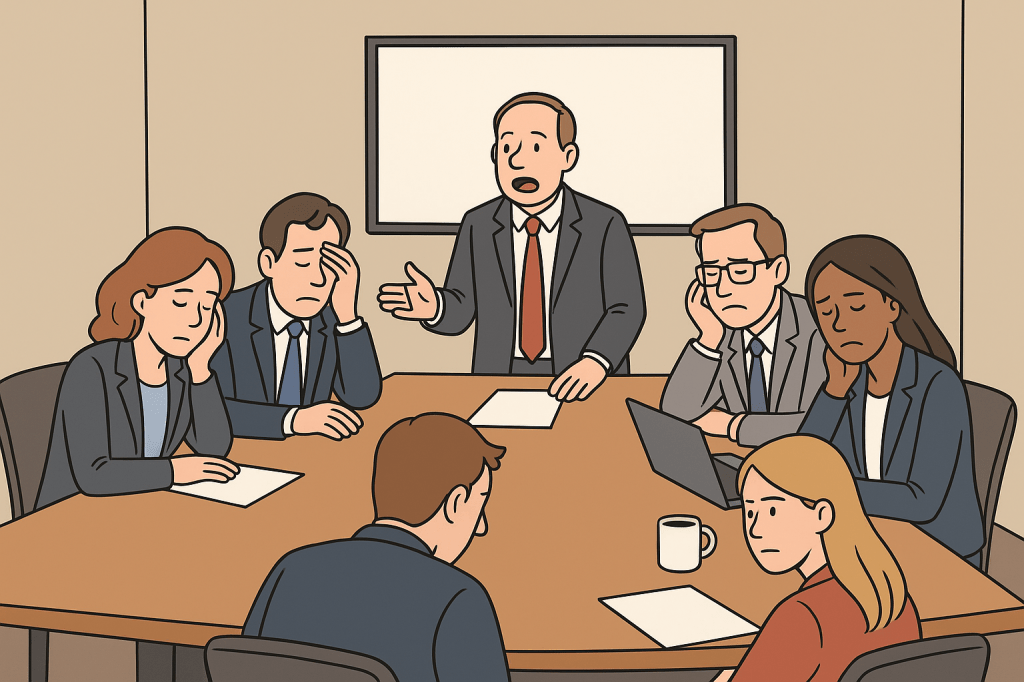
    Watch people enter a conference room.

    The boss takes the head of the table.

    The loyal lieutenants take the seats closest to the boss, carefully positioned according to seniority and established brownie points.

    These are sacred seats.

    It’s easier to get Packers season tickets than to take a brown-noser’s chair at a staff meeting.

    At the far end sit The Rebels.

    They’re the ones asking:

    “Why are we doing this?”

    “This isn’t going to work.”

    “Why don’t we hire more people?”

    And somewhere in the middle are the new employees who haven’t yet figured out that they accidentally sat in someone’s chair.

    They’ll only make that mistake once.

    Let the Meeting Begin

    Nobody arrives on time.

    Therefore, the meeting doesn’t start on time.

    There may or may not be an agenda.

    Finally, the leader arrives 12 minutes late.

    “Sorry. Important call.”

    Of course.

    Then comes the introduction of the new employee.

    “Let’s go around the room. Everyone introduce yourself, tell us a little about your background and what you do here.”

    And we’re off.

    Meet Ralph

    “Hi, I’m Ralph. I’ve been married to Jennifer for seven years. We have two kids, Ralphy, six, and Rachel, three. I’ve been with Acme for five years in customer service.

    This is a great place to work.”

    Translation:

    I hate my job. My boss drives me nuts. I’ve been turned down for promotion four times. Rachel was an uh-oh. Money’s tight. My marriage is strained. I’ve used up my free employee counseling and I’m now watching therapy videos on YouTube.

    “Thanks, Ralph.”

    Next.

    And Now, an Important Corporate Update

    Sales are down.

    Profits are down.

    Therefore, everyone needs to tighten their belts.

    Fortunately, management has developed a comprehensive recovery plan.

    The thermostat can no longer go below 75° in the summer or above 65° in the winter.

    If you’re uncomfortable, adjust your wardrobe.

    But remember the dress code.

    The Christmas party has also been streamlined.

    Spouses can still attend—for $40 in advance or $48 at the door.

    And we’ve made some exciting menu improvements:

    Goodbye beef tenderloin and lobster.

    Hello flank steak and tuna casserole.

    Unfortunately, there will be no Christmas bonuses this year.

    But don’t worry.

    Every employee will receive an eight-pound margarine-ball turkey from Walmart.

    Management Is Sacrificing Too

    Employees may no longer park in the first two rows.

    Those spaces are now reserved for management.

    So while walking six blocks from the employee parking lot, please take a moment to admire the beautiful new stainless-steel enclosure protecting the CEO’s brand-new Mercedes convertible.

    It arrives today.

    “Any questions?”

    Silence.

    Nobody has questions.

    Everybody just wants to go back to work.

    But We’re Not Done Yet

    The boss looks toward HR.

    “I’ll now turn the meeting over to Human Resources for our mandatory quarterly Sexual Harassment PowerPoint presentation.”

    Suddenly…

    The projector doesn’t work.

    A desperate call goes out for Hector, the AV guy.

    But Hector is at the dentist for the rest of the afternoon.

    The presentation has to be postponed.

    For the first time all day, morale improves dramatically.

    There is a God.

    That evening, the guys take Hector out for a beer.

    The Lesson

    After more than 50 years in business, I’ve attended thousands of meetings.

    I’ve forgotten most of what was discussed.

    But I have learned one valuable management principle:

    Sometimes the most productive person in the company is the guy who didn’t fix the projector.

    Thanks, Hector.

    Till we “meet” again.

    Family Life

    Did He Spell It Right? A Catholic Mom, a Can of Paint, and a Brick Wall Showdown .

    The Rhythm Method

    On the Road

    We Took a 1957 Cadillac Hearse to the Prom and Became a Legend

    There’s a Goat on My Corvette

    School Days & Lessons

    Confessions of a Catholic School Survivor

    Funny & Crazy

    My Sheep Dog Screwed up Christmas

    Memorable Family Legends: The Mischief of Grandpa A.D Mac

    When St Christopher Got Fired and Reassigned to Limbo (With a Goat Pension)

    Those God -Awful Christmas Letters

    Family Stories

    We Took a 1957 Cadillac Hearse to the Prom

    The Goat, the Corvette and the Dumpster Surprise

    Did He Spell It Right?

    Christmas, Elton, and the Reindeer

    Grandpa AD Mac – The King of the Prank

    Those God-Awful Christmas Letters

    Why St Christopher Got Fired

    It All Started with Bill and Ginny

    Confessions of a Catholic School Survivor

    Date an Undesirable, See the World,

    Life & Laughs

    Are you a Felix or Oscar?

    Getting Older

    Will Dancing Reduce My Cholesterol

    The Oddities of Funerals — And Why We Celebrate Life Instead

    I Participated in a Triage at the ER

    Business Insanity

    Mergers & Acquisitions — “Nothing Is Going to Change… Right?”

    Welcome to Management – That’ll Cost You $75,000”

    : Meetings

    Other Insanity

    When Trump Leaves Office, America Could Face a Mental-Health Crisis!!

    II Took a Trip to DC

    “Who’s Going to Make This Stuff?” America has $2 Trillion to Build.

    The Humor in Funerals: A Unique Perspective

    Real Stories from the Front Line of Business